Welcome to our website for the latest news on travel, events, food/beer, or just about anything that interests us, or might interest you.

Sunday, July 29, 2007

Patagonia


The drive from Bariloche to El Calafate was long and cold, but 2 days into the journey it was difficult to concentrate on anything but the awesome landscape. The magnificience of an untouched earth and a sky so jealous that it responds with it's own magical displays of colour and contrast.

The cold has been somewhat of a challenge though, especially with no heating on the truck. It's like a fridge in the morning with ice on the inside of the windows. At night the temperatures have been dropping below -5C and along with the rivers and lakes, all our liquid supplies have been freezing. It's quite fortunate that 7 of the group have left early for Buenos Aires to avoid the cold. We now have access to all their sleeping gear and on our second night Jackie used 3 sleeping bags and an Alpaca blanket.

HAPPY COWS


Bariloche is famous for it's chocolate but who cares about that when you're faced with the quality of beef that is commonplace. Most certainly the happiest cows I have ever experienced and we all know that a happy cow makes a happy Bradley. The chef's at El Boliche de Alberto, a restaurant that we visited twice, deserve special mention. They are true geniuses at the grill and deliver the perfect steak time and time again. Apparantly Buenos Aires wins the steak race but we'll have to wait and see.

Night Snowshoeing (by REM?)


After a bus and a jeep (pronounced sheepie in 'Argentinian') ride we were high up in the black mountains overlooking the Moreno Lake and the snow-capped peaks surrounding Bariloche. We fitted our snow-shoes and set off just after sunset. Under the light of a bold moon we crunched confidently along a well trodden path and 5 minutes into the trek we were identified as talented trekkers. The powers that be placed us in an advanced group of 4 with the other 20 (all kids and fat brazilians) being allowed to lag behind, pretty much wallowing in the snow. We ventured forth into fresh snow and unchartered territory and soon realised that not even our hi-tec aluminium snow-shoes would keep us out of trouble. Jackies best move was a graceful headplant and one of my steps saw me sinking waist deep. After our walk we arrived at a refugio overflowing with Argentinian hospitality. We indulged on chocolate fondue and drank bottomless hot chocolate and cognac while listening to some local boys on their guitars. The trip back was a bit of a blur.

Freestylin


In March we enjoyed our first ever skiing holiday in Andorra. We were hoping to put our newly learnt skills to the test so as soon as we found ourselves in Bariloche we sorted out some gear and a 1 day lift pass. We arrived at the slopes like seasoned professionals and made our way to the closest nursery run. We both safely got down, even though I felt like I'd never done it before. Paul, a chap in our group and an advanced skier, took one look and said that we were ready for more. We followed him up a chairlift and stood at the top of a run that made my knees quiver. We started with some confidence but half way down things fell apart. I had just negotiated a section and brought myself to a somewhat graceful stop when Jackie came flying past, lying on her stomach, going feet first down the slope. My legs switched off and I bit the snow the rest of the way down.

We composed ourselves at the bottom and decided to spend the rest of the day on the easier green runs. These turned out to be awesome (in our beginner opinion), with runs all the way from the top of the mountain, contouring around steep ridges and winding through forests. The highlight of my (and Jackies) day was an unintentional ski jump which saw me doing half a back somersault and landing on my back up a bank, ski's perpendicular to the snow. I don't think we'll feature in the next Winter Olympics.

Argentina at last!


Our second attempt at getting into Argentina was far easier. We crossed the snow covered border early in the morning and our passage to the lakeside town of Bariloche was uneventful. Bariloche is Argentina's premier ski location, but after spending 2 and a half days there I can verify that it's much more than that. It was so good that it really deserves 3 entries.

Monday, July 23, 2007

Don´t cry for me Argentina


Yesterday morning we left the cold and wet of Pucon and made our way towards the Argentinian border. Not long into the drive we hit the snow and had to get chains on the tyres. These proved little help and only 5 minutes later we slid half off the road and got ourselves properly stuck.

The snow then came down with some serious gusto and for the next 8 hours we struggled to stay warm. We where quite close to a police checkpoint, so as a group we left the impending chaos of the truck recovery and made our way down to some shelter. The Chilean police, who were cuddling by a raging fire in an office, offered zero assistance and were the most intellectually challenged individuals I have ever encountered. They were quite happy to watch all of us freeze outside. Some of our group (following Jackies lead) broke into a building across the road and got a fire going. I was entertaining myself with some ice sculpturing, my best creation being the EXODUS logo (exodus is the company that we are currently travelling with).
The police then proceeded to get their vehicle stuck in the snow and after spending 20 minutes trying to get it out, they came to ask me for some assistance. I looked at them with a twinkle in my eye and said ´not a chance´.

We arrived back into Pucon last night and that´s were we currently find ourselves, stranded until the roads clear. Argentina will have to wait a bit longer.

Saturday, July 21, 2007

Literary genius


With the many hours spent travelling on the truck, we´ve had a lot of time to catch up on some reading. Jackie has read 9 books and I´ve read 4. I´ve started a few others, but only when a book really grabs me (or on Jackie´s recommendation), do I persevere.

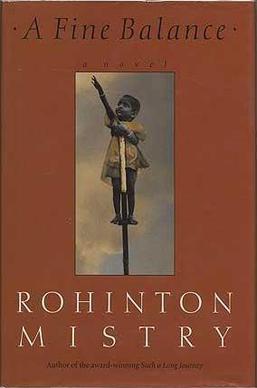
I started with James Patterson´s ´Big Bad Wolf´ which was easy reading and fairly entertaining. Righteous Men, by Sam Bourne, very much like a Dan Brown story was next, and then I read the wonderful ´Kite Runner´ by Khaled Hosseini. I was certain that things couldn´t get any better. I was wrong. I had the privilege of reading ´A Fine Balance´, written by Rohinton Mistry. A story set in India about 3 families of different castes, whose lives came together during a devastating political and social nightmare. The saddest but most beautiful story I have ever read.

Seriously strong espresso


Santiago


We only had a day in Santiago, so decided to make the most of it. We visited a vineyard called Cousino Macul, a subway and taxi ride from the centre of the city. After a tour of the cellars we tasted some of the reserve reds and wow were they good. So good that we walked out with a few bottles. SA was one of the first countries they exported to (picture 3 above).

The city is home to something like 70% of the very well dressed Chilean population and is remarkably similar to any of the European capitals that we have seen. No Big Ben or Eiffel Tower, but restaurants of note. We spoilt ourselves with some sushi and for dinner I had a chilli chocolate steak that was so good I felt a bit emotional eating it.

La Serena


Travelling across the border from Bolivia into Chile was a bit of a culture shock. Like passing through some sort of time warp (not that I´ve been through one before). All of a sudden we had great roads, with everything looking, smelling and sounding familiar, but my word are things expensive. My wallet must have sprung a leak. We spent some time in the coastal city of La Serena, where we joined an evening excursion to the observatory of Cerro Mamalluca. Freezing cold but really worth the trip, we even got to see jupiter and 3 of it´s moons and learnt about the new super earth they recently discovered. The best thing about the city was the volunteer tour guides that follow you around day and night. A thousand optomistic dogs that seem to adopt tourists in a very ordered fashion. We named ours Benji.

Tuesday, July 17, 2007

At a train graveyard, I just had to


Salt on our feet and wind in my pants


Last week we joined an organised 3 day trip through the famous Bolivian Salt Flats, spending the night before in Uyuni, a town at their entrance. I had to mention Uyuni because I ate the best pizza of my life there, at the restaurant in the Toñito Hotel. It was a large spicy llama, spinach, caramalized onion and gorgonzola guy. If anyone ever finds themselves in Bolivia, try get to this joint, it´s seriously worth it.

Our tour through the salt flats was way beyond expectations. We ventured into the belly of the most ruggedly beautiful wedge of the planet that I have ever seen. The salt flats were really cool and way bigger then I ever imagined. We drove (fast) for around 2 hours to get to Fish Island, which is in the middle of the flats. An island with massive cacti and confusing views. We had to copy the hoards of tourists whose footsteps we followed in, and take some perspective free pictures.

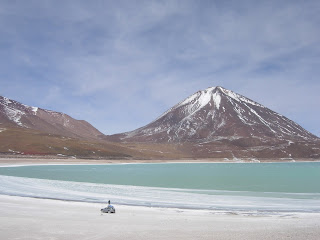
The ´highpoint´ of the trip for me, was crossing the Bolivian Altiplano, a fairytale landscape above the clouds. An area overflowing with minerals, of ground that bubbles and boils, and of weirdly coloured lakes, mountains and masterpieces wherever your eyes wander. The Salvador Dali Desert (named after the man because he dreamed of and painted the place before ever seeing it), the Laguna Verde (a green lake of arsenic located between 3 volcano´s at close to 5000m´s above sea level) and another Lake (Colorado), this time red in colour, with a white island of Borax like a giant cherry pavlova.

Our first evening was spent on a football field, at around 4000m above sea level, and in the dark. The exodus team, 5 of us in all, unbeaten in both Peru and Ecuador, suffered our first defeat, losing 4-3 to a side with a chap that I´m sure could make any English Premier League team.

I managed to tear my pants during our session of creative photography on the salt flats (on the 1st day) and this provided a wonderfully chilled crotch for the entire length of my stay. The morning of the third day of our trip was unbelievably cold and some lateral thinking was required when dressing before heading out.

The tour ended with us crossing the border into Chile, where we now find ourselves.

Monday, July 16, 2007

Overland travel - a typical day

A 4 hour wait for the roads to re-open


A serious leak because of a couple of snowmen on the roof

A llama crossing

Having to push a broken down car out of the way.


Downhill Madness


There is a road just outside of La Paz that connects the snow-capped mountains with the cloud forest below. The narrow and winding road has edges that literally fall into the rain forest, a drop of around 500m´s at times. For good reason it is known as ´Death Road´.

What would a tourist do with such a road you might ask? Well, give them a mountain bike and a helmet, and they´d certainly cycle down it. A 65km journey, starting in the snow at 4650m above sea level, and descending 3350m to the jungle below. A group, including Jacks and myself, gave it a go, and I can honestly say that it´s the craziest thing I´ve ever done. Don´t worry mom, I was very careful (not). We whizzed down the road at a disturbing velocity paying very little attention to the monstrous cliffs at our sides.

After having lunch at the bottom, we made our way back up, this time in a vehicle with a coca leaf chewing driver. The drive up was almost as exciting as the ride down, but the main thing it did was put in perspective what we had just done. Absolutely crazy!

Moon Valley


On the outskirts of La Paz is an area known as Moon Valley. Due to it´s high altitude and lack of humidity, any rain is pretty much absorbed on contact, and it´s lunar landscape is forever maintained. It is also the location of the world´s highest golf course (the green in the back of the first picture).

Into thin air


Our first port of call in Bolivia was it´s ´de facto´ capital of La Paz. The highest capital in the world at 3700m above sea level, the city itself forms a bowl in amongst a ruggedly mountainous landscape. One of the highlights of our short stay was a half day city tour, where we learnt about the city´s past and present. Without wanting to bore, I thought I´d share some of the interesting info.

1) In 2003, an ex-president (Gonzalo Sánchez de Lozada, I think), raised income tax from 12-24%. A peaceful protest against this ruling ended with 35 dead, after orders from this president. He wanted to make a statement, but his popularity pretty much vanished so he decided to jump ship. On his way he popped past the Central Bank of La Paz and ´withdrew´ $80 million. He now resides happily in the USA and still owns around 50% of all the mines in Bolivia. His safety is pretty much assured due to previous connections (business) with George W senior.

2) A fairly recent government initiative saw young woman in La Paz (and elsewhere in Bolivia) being invited to hospitals for free health checks. Without knowing it they were sterilised in an attempt to control Bolivia´s population.

3) The Police Chief of La Paz earns $1250 per day, most of which is made up of a compulsory $10 a day payment to him from each officer. Take into account that most of La Paz´s poor live on less than $2 a day.

4) La Paz must have the weirdest (and most shocking) prison in the world, called San Pedro. Rich criminals very rarely end up in prison, but when they end up in San Pedro, they live in the lap of luxury in rooms with jacuzzi´s, cable television and even servants. They´re allowed female guests whenever they want and spend most weekends outside. In contrast, the poor prisoners don´t even get cells, so in cold and wet conditions have to dig into the thick clay walls for shelter. They also receive no food, so spend most of their time begging, or trying to work for some.

Bolivia is one of the world´s poorest countries, with a vast mineral wealth that has, and still is being robbed of them. Why?

Tuesday, July 10, 2007

What did we ever do to Bolivia?


After our trip on Lake Titicaca we drove around it´s southern edge to the Peru - Bolivia border, a completely crazy place with impossible traffic. With a visa already stamped in my passport, I expected to waltz across the border after a wave and a smile. How could I have made such assumptions, having never set foot in Bolivia before.

We got our exit stamp in Peru and then drove across the border, where we entered the immigration offices. My turn at the counter arrived and I handed my passport over with a smile and a polite ´buenos tardes´. The chap studied it for a while, as if he´d found it in the bin, and then called some of his mates over. After 5 minutes of ball-scratching and nose-picking he handed me my passport back with the words ´Go to Peru to photocopy it´. I almost lost my patience but, thanks to my wife, I managed to hold it together.

The story has a happy ending and half an hour later I was officially in Bolivia.

Lake Titicaca


At 4000m above sea level, it´s the highest of the world´s commercially navigable lakes and is roughly the same size as Puerto Rico. Our first sight of the lake (and departure point) was from the town of Puno, a grubby port with little beauty or significance, but some really lively odours. Our boat´s first stop was one of the Uros Islands. These are manmade floating islands consisting of mud and reeds. Usually an extended family would live on one island, supporting each other through fishing and tourism. What I found really funny was that if two parties have an argument (usually alcohol related) it is fairly common for them to cut their island in two and go their seperate ways.

We jumped back on the boat, and two and a half hours later arrived at an island called Taquille, boasting an extremely organised self-sufficient society. The first inhabitants we encountered were a few men wearing different coloured hats. Apparantly single and married men wear different colours. Our group was told which restaurant to eat at, and after lunch we made our way back down to the waters edge. We approached a herd of sheep and as we got closer I noticed that each sheep had 2 legs tied together. Our guide explained that if a sheep jumps into a neighbours land, a fine is charged for the return of the sheep.

Our last stop for the day and the island that we´d spend the night on was Amantani. On arrival we were met by the chap in charge of homestays. Jackie and myself were introduced to Isabella and her 7 year old daughter Lisadda and we followed them towards their house, a basic structure overflowing with family warmth. After ´checking in´, we were taken up a narrow cobbled pathway to the football field, where we took on and beat the local boys. Quite an impressive feat, taking into account that we were over 4000m above sea level.

That night, after dinner in the kitchen with the family, granny dressed us in local attire and we made our way up to the main hall, where we engaged in a bit of local dancing.

The whole Lake Titicaca experience, especially the homestay, was awesome. A place and a people that we had never heard of, but will never forget.

Monday, July 02, 2007

Norris candidate number 3


The Inca Trail


We spent the last 4 days making our way from km82 to Machu Picchu. Our group was made up of 18 gringo´s, 3 guides, and 24 porters (which included our chef). A maximum of 500 people can start the trail each day, and this number includes porters. Sol, our 26 year old local guide was fantastic from the start. I really feel it makes a huge difference when you have someone who is so passionate about a subject not because she finds it interesting but because she is part of it. At various points along the way she would talk about her families history, and her feelings toward the past and present. She was of mixed blood, both Inca (or Quechua) and Spanish, and her beliefs (both religious and political), were always interesting. She told us that even though she is a Christian, she has held onto her ancestors ideals and still worships mother earth, the sun and the stars. She found it impossible to hide the fact that she hated (and hates?) the Spanish for what they did to her people.

The walk was beautiful, with more mountains than I had expected. The weather was good to us, with no rain whatsoever, but at night the polar bears made an appearance and Jackie was pretty chilly in her sleeping bag. The highest pass was at around 4200m and although at times fairly steep, the walk was very easy.

Another highlight was the food, and as with our previously organised trek up Kilimanjaro, I was shocked with the quality and variety of what we got. Our chef (Hymie) was only 24 and he really knew what he was doing. At one lunch stop there were 10 dishes served.

We passed many Inca sites along the way, but the main attraction and finishing point of the walk was Machu Picchu. We were woken at 3:30 on our 4th and final morning, and we set off around an hour later, only to wait at a control point for an hour. At 5:30, the race to the sun gate began and my blood began to boil. We were first in line and set off as a group, but 10 minutes into the walk, a pair of french idiots came rushing past. I was struggling to understand the logic of these and many others who felt they had to race and then I took a closer look and realised that they all had SWS (small willy syndrome). I was quite proud of Jackie who managed to whack the one with her trekking pole. I was hoping for some form of retaliation (so that I could throw him in the Urubamba river 1500m below) but there was none. Anyway, when we arrived at the sun gate (after walking for only 50 minutes or so) we found that Machu Picchu was still there. Awesome to see, and more amazing I feel, because of its position between 2 beautiful peaks, surrounded by a bowl of mountains. We left the other groups, who were waiting for the sun, and walked down to the site. The sky was perfectly clear, and the sun´s rays descended over us as if a giant set of curtains had opened.

The Inca´s created 40,000 kms of trails during their time, but the path we walked along was the main pilgrimage from Cusco to Machu Picchu. Of all the Inca sites discovered to date, Machu Picchu is the most religious, with many temples and relics of their religious beliefs. Some of the stones in the ruins are pefectly carved replicas of the surrounding mountains.

In our opinion the trail is more of a tourist attraction than a trek, and it´s a huge pity that hoards of tourists are bussed in to the sacred site each day.

Sacred Valley Tour


The day before the start of ´our´ Inca Trail, we visited sites in and around the Sacred Valley of the Inca´s. A place rich in history, because of it´s fertile soil, which is still being well used by the local people, supplying the residents of Cusco with most of their fruit and veg. Something like 4000 different types of potatoes, and more corn than you could ever imagine.

Our tour took us past Sacsaywaman (pronounced sexy woman), Pisac and Ollantaytambo, where we spent the night. A really interesting tour, and a great way to start to get to grips with Inca history and culture. These guys were master architects, and before building anything they extensively researched everything to do with the potential site. Places of worship always higher up (closer to the heaven´s) and with more formal architecture, as opposed to the houses, lower down and with a rustic design. Food warehouses always well postioned in a windy point of a valley, usually up on a mountain side, optimising ventilation. I think the thing that really stood out for me was the way the Inca´s respected their environment. One example of this is their terraces, which were used both for crops, and to protect the mountain side. These were always concave or convex, matching the natural layout of the land.

The Navel of the Inca Empire - Cusco


Cusco, or Cosco (as it should be known), is the gateway to Machu Picchu, the most visited tourist attraction of South America. Evidence of the Inca´s history is widely found, but all of the buildings were raped by the Spanish, who rightly so, don´t seem to popular in these parts. The centre is full of colonial architecture, constructed using the stones of the surrounding Inca temples. It´s a pretty place to explore, but the Irish pubs, tour operators, street vendors and woman and llama´s walking the streets gets a bit much. Tourists = $$$$$$$$$$$$$$$ to the local population, and I don´t blame them, most of these tourist plonkers have no idea.